Not every wet spot needs a professional crew — but knowing the line between a DIY-friendly cleanup and a job that needs certified help can save you from a much bigger problem down the road. Here's how to tell the difference.
In Mesa, the answer depends a lot on how the water got there. A knocked-over glass on a tile floor is one thing; a slab leak under a concrete floor, a swamp cooler overflowing onto a roof, or monsoon floodwater coming in from outside are very different problems, even when the wet patch on the floor looks the same size. This guide walks through what your own equipment can genuinely do, the Mesa situations that change the answer, what each option really costs, and what happens when you call a professional crew instead.
What DIY Drying Can and Cannot Do
A wet-vac, towels, and household fans are genuinely useful tools — for the right job. If you catch a clean-water spill immediately, a wet-vac can pull most of the standing water out of carpet or off a hard floor in minutes, and fans plus a household dehumidifier can finish the job over the next day. The key word is "surface": household equipment dries what it can reach, and on a small spill that is all there is to dry.
The limit shows up as soon as water gets into building materials. Drywall, wood framing, carpet padding, and concrete all absorb water and hold it deep inside, where air from a fan never reaches. A household dehumidifier moves a fraction of the moisture that professional-grade equipment does, and it has no way to push dry air into a wall cavity or under a floor. That is why a wall can feel dry to the touch on the surface while still holding significant moisture inside — exactly the condition mold needs to start growing, often within 24 to 48 hours.
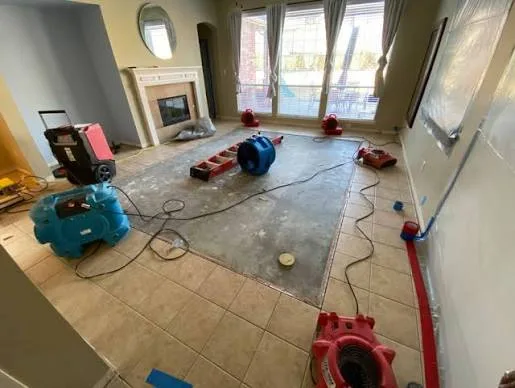
Professionals do not just use bigger fans. They map moisture with meters and thermal imaging, so they know where the water actually went rather than where it looks like it went, and they keep drying until readings confirm the structure has reached the IICRC dry standard — not until it looks dry. If you have no way to measure moisture inside a wall or under a floor, you have no way to know whether your DIY drying actually worked, and that uncertainty is the real risk.
Mesa Situations That Change the Answer
Some water damage in Mesa is almost never a DIY job, whatever it looks like on the surface. A slab leak is the clearest example: the pipe is buried under the concrete slab your home sits on, so the water has been traveling under the floor long before you notice a warm patch, a climbing water bill, or the sound of running water with every tap off. No amount of fans will reach it, and the leak itself needs professional detection and repair before any drying can succeed.
Monsoon flooding is another. Water that comes in from outside during a storm is black water — Category 3 — carrying soil, debris, and contaminants, and it needs protective equipment, proper handling, and disposal of contaminated materials. The same applies to a swamp cooler overflow: the water may look clean, but when it has been dripping slowly into a ceiling or down a wall for days or weeks, the insulation and framing behind the drywall can be saturated in ways you cannot see from the room below. And a burst pipe during a cold snap can release hundreds of gallons in a very short time, spreading across more than one room before you even find the main shutoff valve.
The pattern is simple: if the water came from outside the house, from under the floor, from inside a ceiling, or from a source you cannot fully stop and see, it has almost certainly traveled further than the visible wet patch suggests. That is the point where a free inspection is worth more than a weekend of guessing — a crew can tell you definitively whether the job is DIY-safe or needs certified drying equipment, without any obligation to proceed.
The Real Cost Comparison
It is tempting to compare a professional quote with the price of renting a fan and doing it yourself, but that is not the real comparison. The real comparison is the DIY cost plus the risk of paying for the job again later, against the professional cost once. Minor water damage jobs in Mesa typically run $500–$1,500, moderate jobs $1,800–$4,000, and major jobs $4,000–$6,000+. By water category, clean water is typically $3–$4 per square foot, gray water $4–$7, and black water $7–$10 — and a free inspection with a written quote tells you the exact number for your home before any work begins.
A DIY attempt has its own costs: equipment rental, your time, and the materials you may have to replace anyway. If the drying is incomplete and mold develops or flooring warps weeks later, you end up paying for both — your own attempt, plus a larger professional job that now includes mold remediation or reconstruction that early drying would have prevented. We do not charge separate emergency, inspection, or callout fees, so the quote reflects the actual restoration work needed, and for many Mesa homeowners we can bill the insurer directly for covered work. When the numbers are close, the professional option also buys something a rental cannot: moisture readings that prove the structure is actually dry.
A Safe DIY Checklist for Small Clean-Water Spills
If your situation genuinely matches the DIY side of the line — a small, clean-water spill, caught immediately, in one accessible area — here is how to do it properly. First, stop the source: turn off the supply valve, the appliance, or the tap that caused it. Second, put safety first: if water is anywhere near outlets, appliances, or your electrical panel, do not walk through it and do not plug in equipment until the power to that area is off. Third, extract as much water as you can with towels and a wet-vac, working from the edges of the wet area toward the middle.
Fourth, dry aggressively: run fans to move air across the wet surface and a dehumidifier to pull moisture out of the air, and keep them running for at least a full day, not just until the surface looks dry. Lift rugs, move furniture off wet carpet, and open the area up so air can reach every wet surface. Fifth, monitor for a full week: check for any lingering dampness the next day, any musty smell, or any discoloration on walls, ceilings, or flooring. If the area is still damp after a day or two of fans, if a smell develops, or if you find the water reached under flooring or into a wall, stop and call (480) 806-2186 for a free inspection — that is the moment the job stopped being DIY.
What Happens When You Call a Professional
Calling a professional does not mean handing over your home to strangers — it means getting a clear answer and a measured plan. Our 5-step IICRC S500 process is: call and triage, inspect, extract, dry, and restore. On the call, we ask what happened, what kind of water it is, and how long it has been there, so the crew arrives with the right equipment. We answer 24/7 and aim for a response time of around 40 minutes in Mesa.
On site, the inspection classifies the water category and maps moisture with meters and thermal imaging, including inside walls and under flooring. Standing water is extracted immediately, and any materials that cannot be saved — such as soaked carpet padding — are removed. Then structural drying begins: air movers and dehumidifiers run continuously, and a technician returns daily to take moisture readings until every reading confirms the structure has reached the IICRC dry standard. Most Mesa jobs reach that standard within 3 to 5 days. Finally, repairs and reconstruction put the home back the way it was, and the documentation from every step supports your insurance claim. That is the difference a professional crew brings: not just bigger equipment, but proof — readings, a drying log, and a written scope — that the job is actually finished.
When DIY Is Usually Fine
- Small, clean-water spills caught immediately — a knocked-over glass, a small supply line drip you spotted right away
- Affects a small, easily accessible area — no flooring removal or wall cavities involved
- You can fully dry it within a few hours using towels, a wet-vac, and fans, with no lingering dampness the next day
In these cases, thoroughly drying the area, running a fan or dehumidifier for a day, and monitoring for any smell or discoloration over the following week is usually sufficient.
When You Need a Professional
- Water sat for more than a few hours — especially overnight or while you were away
- The water is gray or black category — sewage, appliance overflow, or flooding from outside
- Water affected more than one room or traveled under flooring/into walls
- You can't get flooring or drywall fully dry — persistent dampness after a day or two of fans
- There's a musty smell that doesn't go away, suggesting hidden moisture or early mold growth
- The source was a pipe, roof, or slab leak rather than a one-time accident — these often mean water has traveled further than visible
Why the Distinction Matters
Household fans and a wet-vac aren't designed to fully dry building materials — a household dehumidifier moves a fraction of the moisture that professional-grade equipment does. Structural materials can feel "dry to the touch" on the surface while still holding significant moisture inside, which is exactly the condition mold needs to start growing, often within 24 to 48 hours.
The Cost of Guessing Wrong
A DIY attempt on a job that actually needed professional drying often means paying for both — your own time and equipment rental, plus a larger professional job later once mold or structural damage has developed. When in doubt, a free inspection can tell you definitively whether a job is DIY-safe or needs certified drying equipment, without any obligation to proceed.
Dealing with water damage right now in Mesa?
Call (480) 806-2186 for a free inspectionRelated reading
DIY or Professional? A Quick Comparison
Frequently Asked Questions
Can I dry water damage myself with fans and a dehumidifier?
For a small, clean-water spill caught immediately in one accessible area, yes — towels, a wet-vac, fans, and a dehumidifier run for at least a full day are usually enough. But household equipment cannot dry inside wall cavities, under flooring, or inside concrete, and a surface that feels dry can still hold significant moisture inside, which is exactly what mold needs to grow within 24 to 48 hours.
How do I know if water damage needs a professional?
Call a professional if the water sat for more than a few hours, especially overnight or while you were away; if it is gray or black water; if it affected more than one room or traveled under flooring or into walls; if dampness lingers after a day or two of fans; if there is a musty smell; or if the source was a pipe, roof, or slab leak. When in doubt, a free inspection gives you a definitive answer with no obligation to proceed.
Is DIY water damage cleanup cheaper than hiring a professional?
Not always. A DIY attempt on a job that actually needed professional drying often means paying for both — your own time and equipment rental, plus a larger professional job later once mold or structural damage has developed. Minor professional jobs in Mesa typically run $500–$1,500, and the inspection and written quote are free, so you can compare real numbers before deciding.
Can I clean up sewage or floodwater myself?
No. Gray and black water — sewage, appliance overflow, and flooding from outside — carry bacteria and other pathogens and should never be cleaned up without proper protective equipment. Black water jobs also require containment and disposal of contaminated materials. Call (480) 806-2186 any time, day or night, and keep people and pets out of the affected area until help arrives.
How long should I run fans after a small spill?
Keep fans and a dehumidifier running for at least a full day after a small clean-water spill, not just until the surface looks dry, and then monitor the area for a full week for lingering dampness, a musty smell, or discoloration. If the area is still damp after a day or two, or a smell develops, the water has gone deeper than your equipment can reach and it is time to call a professional.
What does a professional inspection include?
Our free inspection classifies the water category, maps moisture with meters and thermal imaging — including inside walls and under flooring — and gives you a written quote before any work begins. The crew follows a 5-step IICRC S500 process: call and triage, inspect, extract, dry, and restore, with daily moisture readings until the structure reaches the IICRC dry standard.