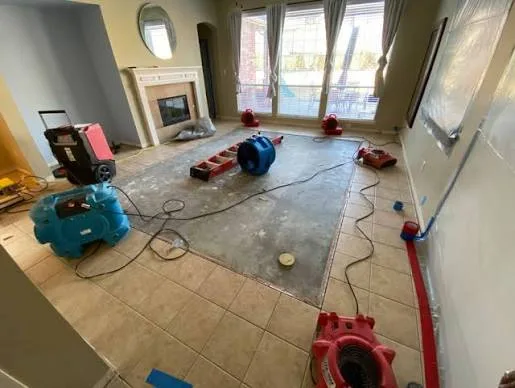
When a restoration crew finishes drying your home and tells you it is dry, how do you know they are right? The walls look dry. The floor feels dry. The equipment is gone. But water hides in places you cannot see or feel — inside wall cavities, under flooring, in the concrete slab itself — and a home that looks dry on the surface can still be wet enough inside to grow mould, warp flooring, and fail months later. That is why professional drying is not judged by appearance. It is judged by readings.
This guide explains how structural drying is verified: the tools technicians use, what the numbers mean, what a proper drying log looks like, and what you should ask before you accept that a job is done. If you have water damage in your Mesa home, this is the knowledge that lets you hold the work to a standard — and spot it quickly if a company is cutting corners.
Why "Looks Dry" Is Not Dry
Building materials absorb water like a sponge and release it slowly. Drywall can look dry on the surface while the back of the panel and the insulation behind it are still soaked. Tile can feel dry while the slab beneath it holds a large amount of moisture. Wood flooring can feel firm while the subfloor underneath is still wet enough to swell and cup weeks later. The drying process works from the outside in, and the last places to dry are exactly the places you cannot see.
That is the central problem structural drying solves, and it is why time-based promises — "three days and it will be dry" — are only a rough guide. Most water damage jobs take 3–5 days from extraction to a fully dry structure, which is the range we quote on this site, but the actual time depends on how much water there was, which materials were affected, and the temperature and humidity in the home. A thick concrete slab that has been soaking for weeks will take longer than a surface spill on tile. The only way to know the structure is dry is to measure it, repeatedly, until the measurements say so.
Moisture Meters: Pin and Pinless
The two basic tools are the pin meter and the pinless meter, and a good technician uses both. A pin meter has two small probes that are pressed into the material. It measures the electrical resistance between the probes, which changes with moisture content, and it gives a reading for the material at the depth the pins reach. Pin meters are precise and can measure at depth, but they leave small holes, so technicians use them where the holes will not show or where the material is being removed anyway.
A pinless meter works differently: it sends an electromagnetic signal into the material and measures how the signal is affected, giving a relative reading over a small area without making holes. It is ideal for scanning large areas quickly — sweeping a wall to find the wettest sections, or checking a floor without damaging the finish. Used together, the two meters complement each other: the pinless meter finds where the moisture is, and the pin meter confirms how deep it goes.
Both meters need a reference point to mean anything. A reading of a wet wall is only informative if you know what the same material reads when it is dry. That is why the first thing a technician does is take readings from an unaffected area of the same material in the same home — a dry section of the same type of drywall, the same flooring in another room. That dry reading becomes the target: the job is not finished until the wet areas read the same as the dry ones.
Relative Humidity, Temperature, and Dew Point
Drying is not only about the materials — it is about the air around them. Wet materials release moisture into the air, and if the air is already saturated, the materials cannot dry. That is why dehumidifiers are central to structural drying: they pull moisture out of the air so the materials can keep releasing theirs. Technicians measure the relative humidity and temperature of the indoor air, and they track the dew point — the temperature at which moisture in the air condenses — because it tells them whether the drying conditions are actually working.
A hygrometer or thermo-hygrometer measures air temperature and relative humidity in the affected rooms and, for comparison, outdoors. These readings are taken at the same time as the moisture meter readings, and together they tell the story of the job: is the air dry enough for the materials to release moisture? Is the dehumidifier keeping up with the moisture the materials are giving off? Are conditions improving day by day? If the air readings stall while the material readings are still high, something needs to change — more airflow, a larger or additional dehumidifier, or a check for a water source that is still feeding the area.
Mesa's dry outdoor air is a genuine advantage here. On a typical dry day, the outside air is far drier than the air inside a wet home, and that helps drying along. But it is not a substitute for measurement: a home can have dry outdoor air and still have a wet wall cavity that the outdoor air never reaches.
The Drying Log: What Proper Documentation Looks Like
A professional drying job produces a daily log, and you are entitled to see it. The log records, for each affected area, the moisture meter readings, the air temperature and relative humidity, the equipment in place — how many air movers and dehumidifiers, and where they are positioned — and the date and time of each reading. The same points are measured each day, so the readings form a trend: high on day one, lower on day two, lower still on day three, until they reach the dry standard.
That trend is what verification means. A single reading on a single day proves very little. A series of readings, taken at the same points, showing a steady fall to the dry reference level, proves the structure is dry. If the readings plateau — the same number day after day — the technician should investigate why: is there trapped water behind a baseboard, a wet material that has not been removed, or a leak that is still active? A plateau is information, not a failure, as long as someone acts on it.
Ask to see the log before the equipment is removed. A company that cannot show you a log, or that removes equipment after a fixed number of days without taking final readings, is not verifying its work — it is guessing. Our crews follow the IICRC S500 process on every job: call and triage, inspect, extract, dry, and restore. The inspection maps the moisture before drying starts, the drying is monitored with daily readings, and the job is not signed off until the readings confirm the structure is dry.
Air Movers and Dehumidifiers: What They Do
Air movers are the high-velocity fans you see during a drying job. Their job is not to blow air at the wet surface for comfort — it is to push dry air across the surface so the moisture evaporating from the material is carried away, and to create airflow inside wall cavities when baseboards are removed or small openings are made. They are positioned at angles that drive air along walls and across floors, and they are moved as the drying progresses so no wet area is left out of the airflow.
Dehumidifiers remove the moisture from the air that the air movers have picked up. Without them, the air would become saturated and drying would stop. The two work as a system: the air movers move moisture from the materials into the air, and the dehumidifiers move it out of the air and down a drain or into a collection tank. That is why both are needed, and why a job that uses fans alone — or a household dehumidifier alone — does not dry a structure properly. The equipment is sized to the job: a large, heavily affected area needs more capacity than a small one, and the technician's readings tell them whether the setup is enough.
Homeowners sometimes ask whether they can speed the job up by opening windows or running the air conditioning. The answer depends on conditions, and the technician will advise. In Mesa's dry heat, opening windows can sometimes help; during a humid monsoon stretch, it can work against the dehumidifiers. Follow the technician's guidance rather than improvising — the readings will show whether the approach is working.
What "Dry" Means: The Dry Standard
The dry standard is the target the readings must reach, and it is defined by the home itself, not by a generic number. The technician establishes it by measuring unaffected materials of the same type in the same home — the same drywall in a dry room, the same flooring in an unaffected area. The wet areas must return to readings that match those dry references before the job is considered complete. That is the standard we apply, and it is the standard the IICRC S500 framework is built around.
Different materials have different behaviours. Drywall that has been saturated often cannot be dried in place and is removed; the standard then applies to the framing and materials behind it. Wood takes longer than drywall. Concrete takes longest of all, because it is dense and holds a large amount of water — a slab that has been wet for weeks can take many days of drying, and its readings fall slowly. A technician who understands this will not be surprised by a slow slab; they will plan for it and keep measuring until it reaches the standard.
What Happens If Drying Stops Too Early
Stopping drying before the structure is verified dry is the most expensive shortcut in water damage restoration. The visible surfaces look fine, the equipment is collected, the repairs are done — and then, weeks or months later, the problems appear. Mould grows inside the wall cavity where the drywall is still damp. Flooring cups or buckles as the subfloor releases its trapped moisture. Paint peels, baseboards warp, and a musty smell settles into the room. By the time these symptoms appear, the repair work that covered the damp structure has to be opened up again, and the job costs far more than finishing the drying properly the first time would have.
This is why verification matters to you as the homeowner, and why it matters to your insurer. An insurer that sees a drying log with readings trending to the dry standard has confidence the job was done properly. A claim with no readings and a quick equipment removal invites questions later, when secondary damage appears. Keep the drying log with your claim file, alongside the photos, the inventory, and the invoices.
Costs for the overall job depend on the extent of the damage. On this site we publish the ranges we work with: minor jobs typically run $500–$1,500, moderate jobs $1,800–$4,000, and major jobs $4,000–$6,000 or more, with clean water at $3–$4 per square foot, gray water at $4–$7, and black water at $7–$10. Every job starts with a free on-site inspection and a written scope before any work begins. We are IICRC certified, licensed and bonded, with 14 years of experience and more than 3,500 jobs completed across Mesa and the East Valley, and a 97% satisfaction rate. Our crews reach Mesa homes in about 40 minutes on average, 24/7 — call (480) 806-2186.
Tools Used to Verify Structural Drying
Frequently Asked Questions
How long does structural drying take?
Most water damage jobs take 3–5 days from extraction to a fully dry structure, with additional time for repairs. The actual time depends on how much water there was, which materials were affected, and conditions in the home. Concrete slabs that have been wet for a long time can take longer. The job is finished when the readings reach the dry standard, not when a fixed number of days has passed.
Can I tell if my home is dry just by touching the walls?
No. Surfaces can feel dry while the inside of a wall cavity, the back of the drywall, or the slab underneath is still wet. Only moisture meter readings — compared with a dry reference reading from the same material in your home — can confirm the structure is dry.
What is a dry standard?
The dry standard is the moisture reading of the same material in an unaffected part of your home. The technician measures dry drywall, flooring, or wood in a room that was not affected, and that reading becomes the target. Wet areas must return to that level before the job is signed off.
Why do you use both pin and pinless moisture meters?
They do different jobs. A pinless meter scans large areas quickly without making holes, which finds where the moisture is. A pin meter measures at depth, which confirms how far the moisture goes into the material. Used together, they give a complete picture that neither gives alone.
Can I remove the drying equipment early to get my home back?
It is tempting, but early removal is the most common cause of secondary damage — mould inside walls and flooring that warps weeks later. If the readings have reached the dry standard, the equipment comes out; if they have not, it stays. Ask to see the drying log and the latest readings before agreeing to removal.
Will my insurance accept moisture readings as proof the job was done?
Yes — a drying log with dated readings trending to the dry standard is exactly the kind of documentation insurers expect. Keep it with your photos, inventory, estimates, and invoices for the whole claim. We produce these records as part of every job and can bill your insurer directly.
Structural drying is verified by measurement, not by appearance and not by the calendar. Ask for the readings, ask for the dry standard, and ask to see the log before the equipment leaves. If a company cannot show you those things, it has not verified its work. If water damage has hit your Mesa home, call (480) 806-2186 now for a free inspection. Read more on our structural drying and water extraction and mitigation pages, our water damage restoration cost guide, and the rest of the blog.
Serving All of Mesa, AZ
We serve homes across Mesa, AZ — including Downtown Mesa, Dobson Ranch, Superstition Springs, Power Ranch, Eastmark, Las Sendas, Alta Mesa, Augusta Ranch, Val Vista Lakes, Red Mountain Ranch, Fiesta District, Sunland Village, and the surrounding East Valley communities of Gilbert, Chandler, Tempe, Queen Creek, Apache Junction, Scottsdale, San Tan Valley, Sun Lakes, Ahwatukee, and Fountain Hills. If water damage strikes anywhere in the area, our crews are on call 24/7.
Dealing with water damage right now in Mesa?
Call (480) 806-2186 for a free inspection