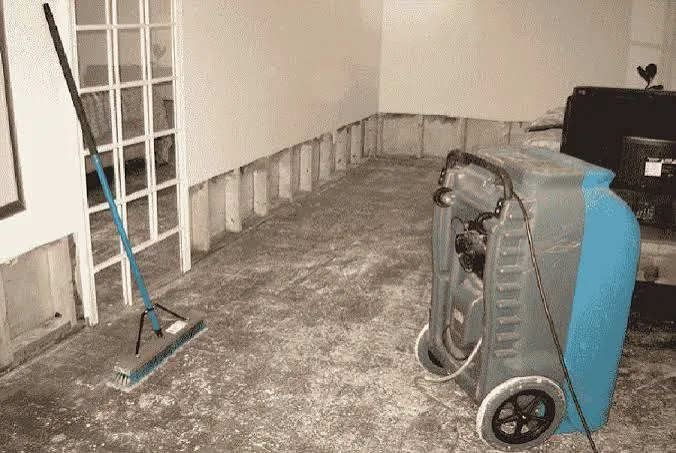
After water damage, the question homeowners ask most often — after "how bad is it?" — is "do I have mould?" It is a fair question. Mould follows moisture, and Mesa's heat makes the conditions inside a wet wall or under a wet floor warm enough for growth to start quickly. The risk of mould growth begins within 24 to 48 hours of materials getting wet, which is why drying speed matters so much. But the question of whether to test for mould, what kind of test to get, and what the results actually mean is more complicated than most people expect.
This guide explains when mould testing makes sense after water damage in your Mesa home, what the different types of testing can and cannot tell you, and what to do with the results. The short version: testing is a useful tool in specific situations, but it is not always the right first step — and visible mould or a known water intrusion often needs remediation and drying first, not a test to confirm what is already obvious.
Why Mould Follows Water Damage
Mould is a type of fungus that grows on damp organic material — drywall paper, wood, carpet backing, dust, and insulation. It needs three things: moisture, a food source, and time. A water intrusion provides all three at once. The materials in a typical Mesa home are full of food for mould, and once they are wet, growth can begin within a day or two. That is why the first 24 to 48 hours after a leak are so important: dry the materials within that window and mould usually never gets a foothold; leave them wet for a week and it often does.
Mesa's climate adds a twist. The dry outdoor air makes people assume mould is not a desert problem, but mould does not grow outdoors — it grows inside, in the damp, enclosed spaces water creates: inside walls, under flooring, behind baseboards, and in closets where wet drywall sits undisturbed. Air conditioning keeps indoor temperatures comfortable for mould as well as for people, and the same swamp coolers that keep homes cool add humidity to indoor air. A slow leak that no one notices is the ideal setup, whatever the weather is doing outside.
Signs You May Have Mould After Water Damage
The most obvious sign is visible growth: black, green, brown, or white spots or patches on walls, ceilings, baseboards, or flooring, often in a pattern that follows a water stain or a damp area. But mould is often hidden. The other signs are just as important. A musty, earthy smell that does not go away after cleaning — especially in a room that had water damage — is a strong indicator, because the smell comes from the gases mould produces as it grows. Paint or wallpaper that bubbles, peels, or feels soft, drywall that is discoloured or crumbling, and flooring that is warped or pulling away from the wall can all indicate moisture and mould behind the surface.
Some people notice health symptoms that seem worse at home and better elsewhere — irritated eyes, throat, or skin, coughing, or a stuffy nose that never quite clears. These symptoms have many possible causes and are not proof of mould on their own, and this guide does not offer medical advice. But if symptoms appear after water damage and improve when you spend time away from the house, that pattern is worth mentioning to your doctor and to the restoration professional inspecting your home. Never try to diagnose a health problem from a mould test result; talk to a clinician.
When Testing Makes Sense — and When It Does Not
Mould testing makes sense in a few specific situations. First, when you can smell mould or have symptoms that suggest it, but cannot see any growth and do not know where it is. A test can help confirm whether mould spores are elevated indoors and guide the search for the hidden source. Second, after remediation is complete, when you want independent confirmation that the work succeeded — a clearance test, sometimes called a post-remediation verification. Third, in a dispute: with a landlord, a seller, a buyer, or an insurer, where an independent written result carries weight that a visual inspection does not.
Testing makes less sense when the mould is visible and the water source is known. In that case, the priority is to fix the water source, dry the structure, and remove the affected materials — testing first only delays the work and adds cost without changing the plan. It also makes less sense as a general "is my house safe?" screen. Mould spores are present in every home and in outdoor air, so a test will almost always find some mould. The question is never "is there any mould?" but "is there a mould problem caused by this water damage, and where is it?" A test that is not tied to that question produces numbers that are hard to interpret.
If you are unsure, start with a professional inspection rather than a test. An inspection with moisture meters maps exactly which materials are wet and where mould is likely to be growing, and it produces a plan for drying and remediation. Testing can then be added if the inspection leaves a genuine question unanswered.
Types of Mould Testing, in Plain Language
Air sampling is the most common type of test. A pump draws a measured volume of air through a cassette that traps airborne spores, and a laboratory counts and identifies them. The result is usually compared with an outdoor air sample taken at the same time, because outdoor air is the baseline — indoor levels that are much higher than outdoor levels, or indoor types that do not appear outdoors, suggest an indoor source. A single air sample is a snapshot of one moment, not a complete picture, and the result depends heavily on conditions at the time of sampling: whether the air conditioning was running, whether anyone had recently disturbed dust, and even the weather.
Surface sampling tests a specific visible patch: a swab, a tape lift, or a bulk sample of the material itself, sent to a lab for identification. This answers a narrow question — what is growing on this spot? — and it is useful when you need to know whether a particular patch is mould and what type it is. It does not tell you what is growing inside the wall behind the patch.
Moisture mapping is not a mould test, but it is often the most useful investigation of all. Using pin and pinless moisture meters, a technician maps which walls, floors, and ceilings are wet and how wet they are. Because mould needs moisture, the wet map is effectively a map of where mould is likely to be growing. In many jobs, moisture mapping plus a visual inspection answers the question faster and more usefully than any lab test.
There are also do-it-yourself test kits sold online and in stores. These usually involve leaving a petri dish open in a room or swabbing a surface and mailing it to a lab. Their results are hard to interpret without an outdoor comparison sample and without knowing the conditions of the test, and they cannot tell you where a hidden problem is. A professional inspection is a better use of the money in most cases.
What Test Results Mean — and What They Do Not
A lab report lists the types of mould found and their concentrations, and it may flag certain types as common allergens. What it does not do is give you a simple safe-or-unsafe verdict, because there is no widely agreed indoor mould exposure limit that applies to every home and every person. Two homes with similar results can be very different situations: one may have a small, contained patch that is easy to remove, while the other has mould spread through wall cavities. The numbers alone do not tell you that. What matters is the combination of the test result, the inspection findings, and the moisture map.
Be cautious of anyone who uses a test result to sell an expensive, open-ended remediation plan without showing you the moisture readings and the affected areas. A trustworthy remediation plan is specific: it names the rooms and materials affected, describes the containment that will be set up, explains what will be removed and what will be cleaned and dried, and says how the work will be verified when it is finished — usually with a visual inspection and moisture readings, and a clearance test if one was agreed in advance.
What Remediation Involves
Mould remediation after water damage follows a logical sequence. First, the water source is fixed — there is no point removing mould while water is still coming in. Second, the wet structure is dried, because mould cannot be controlled in materials that stay wet. Third, the affected materials are dealt with: porous materials that are heavily affected, such as soaked drywall, insulation, and carpet padding, are usually removed and disposed of; hard, non-porous surfaces can often be cleaned. Containment — plastic sheeting and negative air pressure — is set up around the work area so spores are not spread through the house during removal.
Small, contained patches can sometimes be handled as part of the overall water damage job. Larger or widespread growth, growth inside wall cavities, or growth in heating and cooling systems needs a dedicated remediation plan with proper containment and protective equipment. Our crews follow the IICRC S500 process on every job — call and triage, inspect, extract, dry, and restore — and mould remediation is coordinated with the drying so the home is dry, clean, and verified before repairs begin. We are IICRC certified, licensed and bonded, with 14 years of experience and more than 3,500 jobs completed across Mesa and the East Valley, and a 97% satisfaction rate. Our crews reach Mesa homes in about 40 minutes on average, 24/7 — call (480) 806-2186.
Costs depend on how much material is affected and how far the moisture spread. On this site we publish the ranges we work with: minor jobs typically run $500–$1,500, moderate jobs $1,800–$4,000, and major jobs $4,000–$6,000 or more, with clean water at $3–$4 per square foot, gray water at $4–$7, and black water at $7–$10. Every job starts with a free on-site inspection and a written scope before any work begins.
Preventing Mould After the Job Is Done
Once a home is dry and repaired, prevention is about keeping it dry. Fix leaks promptly — the same warning signs in this guide apply to every future leak, not just this one. Keep indoor humidity in check, especially in bathrooms and kitchens, and make sure exhaust fans vent outside rather than into the attic. Check the ceilings below swamp coolers and roof valleys after storms, and check under sinks and behind toilets every few months for slow drips. If a room has had water damage before, check it first after every monsoon storm.
The single most effective habit is speed. Every water intrusion that is dried within the first day or two is a mould problem that never happens. That is why we answer the phone 24/7 and why our crews aim to be on site in about 40 minutes: the clock that matters for mould starts the moment materials get wet.
When to Test After Water Damage
Frequently Asked Questions
How soon after water damage can mould start growing?
Mould growth can begin within 24 to 48 hours of materials getting wet. That is why fast extraction and drying matter so much — drying within that window usually prevents a mould problem from starting at all. If materials have been wet for several days, assume mould is a possibility and have the area inspected.
Should I test for mould before calling a restoration company?
Usually not. Start with a professional inspection: moisture meters and a visual check will show what is wet and where mould is likely to be. Testing is most useful when the inspection leaves a genuine question — such as a musty smell with no visible growth — or when you need an independent result after remediation.
Can I test for mould myself with a store-bought kit?
You can, but the results are hard to interpret without an outdoor comparison sample and controlled conditions. A kit can confirm that mould spores exist in a room, but mould spores exist in nearly every home. A professional inspection and moisture mapping usually answer the real question — where is it growing and how far has it spread — more reliably.
Does a mould test tell me if my home is safe?
No test gives a simple safe-or-unsafe verdict, because there is no widely agreed indoor mould exposure limit that applies to every home and every person. A test result is one piece of evidence, to be read together with the inspection findings and the moisture map. If you have health concerns, talk to your doctor.
Will drying alone get rid of mould?
Drying stops mould from growing, but it does not remove mould that has already grown on porous materials such as drywall and insulation — those materials usually need to be removed. Hard surfaces can often be cleaned once dry. The full plan depends on what the inspection finds, and it is set out in writing before work begins.
How do I know remediation worked?
The work should be verified: a visual inspection confirming the affected materials are removed or cleaned, moisture readings showing the structure is dry, and — if one was agreed in advance — a clearance test by an independent tester. We do not consider a job finished until the structure is confirmed dry by readings.
Mould testing is a tool, not a verdict. Use it when it answers a real question — a hidden source, a clearance check, a dispute — and start with an inspection and fast drying in every other case. If water damage has hit your Mesa home, call (480) 806-2186 now for a free inspection. Read more on our mold remediation and structural drying pages, our water damage restoration cost guide, and the rest of the blog.
Serving All of Mesa, AZ
We serve homes across Mesa, AZ — including Downtown Mesa, Dobson Ranch, Superstition Springs, Power Ranch, Eastmark, Las Sendas, Alta Mesa, Augusta Ranch, Val Vista Lakes, Red Mountain Ranch, Fiesta District, Sunland Village, and the surrounding East Valley communities of Gilbert, Chandler, Tempe, Queen Creek, Apache Junction, Scottsdale, San Tan Valley, Sun Lakes, Ahwatukee, and Fountain Hills. If water damage strikes anywhere in the area, our crews are on call 24/7.
Dealing with water damage right now in Mesa?
Call (480) 806-2186 for a free inspection